Russia to track EARTH-THREATENING asteroids from robot-inhabited nuclear-powered polar Moon base
by RT
Russia to track EARTH-THREATENING asteroids from robot-inhabited nuclear-powered polar Moon base
Moon’s southern pole will be a good spot for an observatory that together with space-based telescopes help find dangerous asteroids. Russia plans to build one as part of an ambitious lunar base project.
Conquering the moon is on the Russian space agency’s to-do list for the not-so-distant future. Roscosmos is currently working on a comprehensive plan that the Russian government wants to see before allocating any money for it. Part of a permanent Russian base envisioned on the Moon will be given to an observatory that will serve as part of a “global system for tracking asteroid and comet threats,” a senior Roscosmos official said in a recent interview.
“The location selected for the base is southern pole of the moon. It has favorable relief and conditions: enough light for solar panels, constantly shadowed craters with ice reserves for fuel and raw material,” Aleksandr Bloshenko explained.
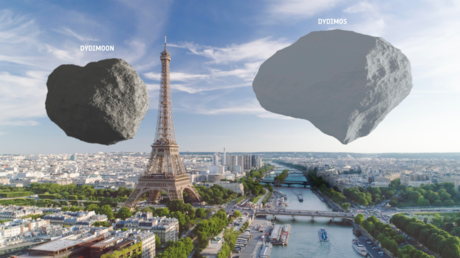
Bloshenko is Roscosmos chief executive for science and advanced projects, and says, from his standpoint, Russia should not expect commercial return on the investments into the base. But there will be scientific value not only from studying the Earth satellite itself, but also deep space. Part of the base will be given to an observatory that, together with spacecraft placed in Sun-Earth Lagrange points, will give humanity an earlier warning should a dangerous asteroid come towards our planet.
More importantly, the base will be a safe place to test technologies for further space expansion, like small-scale nuclear reactors that Russia is currently developing at fast pace, or robotics. In fact, robots are supposed to be the permanent crew of the outpost, while meat-and-bones folk are to come and go “to do the tasks that the robots are incapable of doing.”
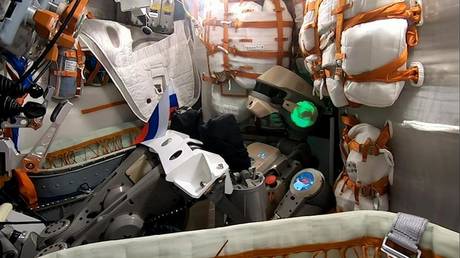
Russia recently flew a remotely-controlled robot to the International Space Station (ISS). Bloshenko says Skybot F-850, also known as FEDOR (Final Experimental Demonstration Object Research) is obviously an early attempt and not a preview for how the inhabitants of the future base will look like. When those walk the moon, it won’t be on feet.
“We have more or less chosen the platform for the future planetary robotic systems. It will be a wheeled walking cart that can either roll on wheels or step over obstacles,” he said. “Another conceptual design is a centaur-like robot on a walking cart for non-trivial planetary tasks”.
Roscosmos is currently accessing how much it wants to develop the ISS, as opposed to focusing on the race to the moon, its head Dmitry Rogozin said this week. In fact two of the modules it is planning to add to the orbital station may be repurposed for a lunar project, he said.
“The life expectancy of the ISS is clear, its 2028, and the modules are good to last for 15 to 20 years. Is it worth sending them for three to four years and later sink it with the entire station? I am not so certain,” he explained.
Rogozin was referring to the science and energy NEM module and the nodal docking module Prichal, which are planned for launch in the early 2020s.